


In the hills or during a general emergency, water comes first. You can go weeks without food, but after three days without hydration you are finished. The real danger is that dehydration clouds judgment exactly when you need to think clearly. That is why knowing how to find and treat water is the most important skill any survivor can have. But beware: in nature, crystal-clear water does not mean safe water. Drinking untreated water is buying a ticket to an infection that will dehydrate you even faster.
Where to look: Reading the landscape If you run out of reserves, the easiest approach is to search low ground. Water always seeks the bottom of valleys by gravity. In dry country, watch the vegetation: a line of greener trees or the presence of reeds and ferns signals shallow groundwater — time to dig. Animals are good guides too: game trails converging downhill often lead to a watering hole, and birds tend to fly low and straight toward water at dawn and dusk.
Gear needed: A small camp shovel (or, failing that, a sturdy stick carved into a wedge) for digging seep wells in dry riverbeds.
Collection options: Use what falls from the sky If there are no rivers or springs nearby, your best ally is the sky. Rainwater collection is the cleanest option because it never touches the ground. Improvise a collector by stretching a clean tarp between four trees, with a stone in the centre to create a drip point into your container. Another field-expedient technique is the plastic still: wrap a leafy branch of a live tree in a clear plastic bag and tie it tight; leaf transpiration will produce distilled water at the bottom of the bag after a few hours in the sun.
Gear needed: A waterproof tarp, paracord, and large clear plastic bags (heavy-duty trash bags work perfectly).
The non-negotiable process: Filter and purify Once you have water, treat it in two phases:
Phase 1: Mechanical filtering (Remove coarse debris). The goal is to strip out mud, sand, and large parasites (such as amoebae). If the water is very cloudy, improvise a pre-filter by running it through a cotton bandana so you do not clog your main kit. Then use a membrane inline filter (Sawyer-type).
Gear needed: Cotton bandana, portable survival water filter, and flexible bottles or bladders compatible with the filter.
Phase 2: Purification (Kill the invisible). Standard portable filters remove bacteria, but viruses are small enough to slip through. To be sure, you have two operational options:
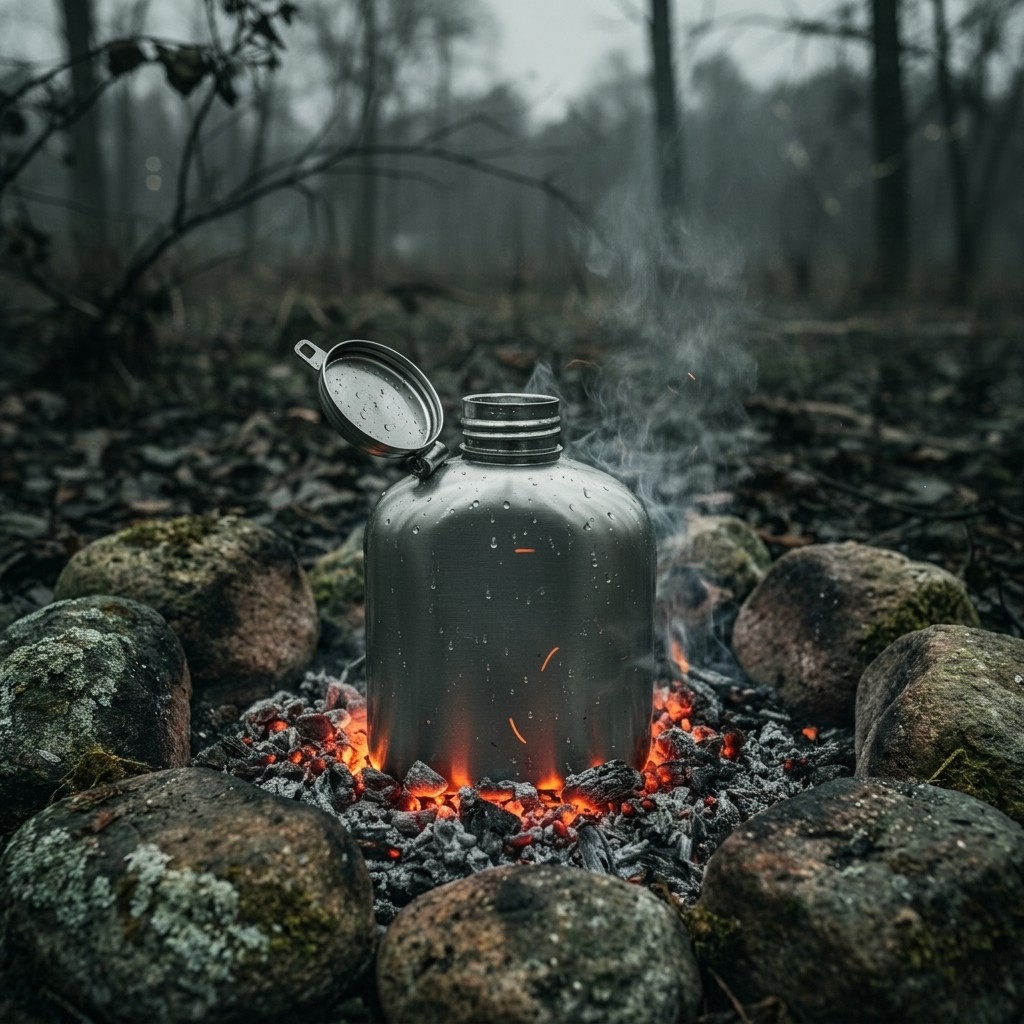
Boiling: The foolproof method. Bring water to a rolling boil for at least one full minute (three minutes at high altitude). That destroys any virus or bacterium.
Purification tablets: If you cannot make fire, chlorine dioxide or medical chlorine tablets are the alternative. Follow the manufacturer's instructions (usually one tablet per litre) and respect the wait time (about 30 minutes) before drinking.
Gear needed: A cup, pot, or mug in stainless steel or titanium (safe for direct fire), spare purification tablets in your first-aid kit, and a clean container to store treated water.